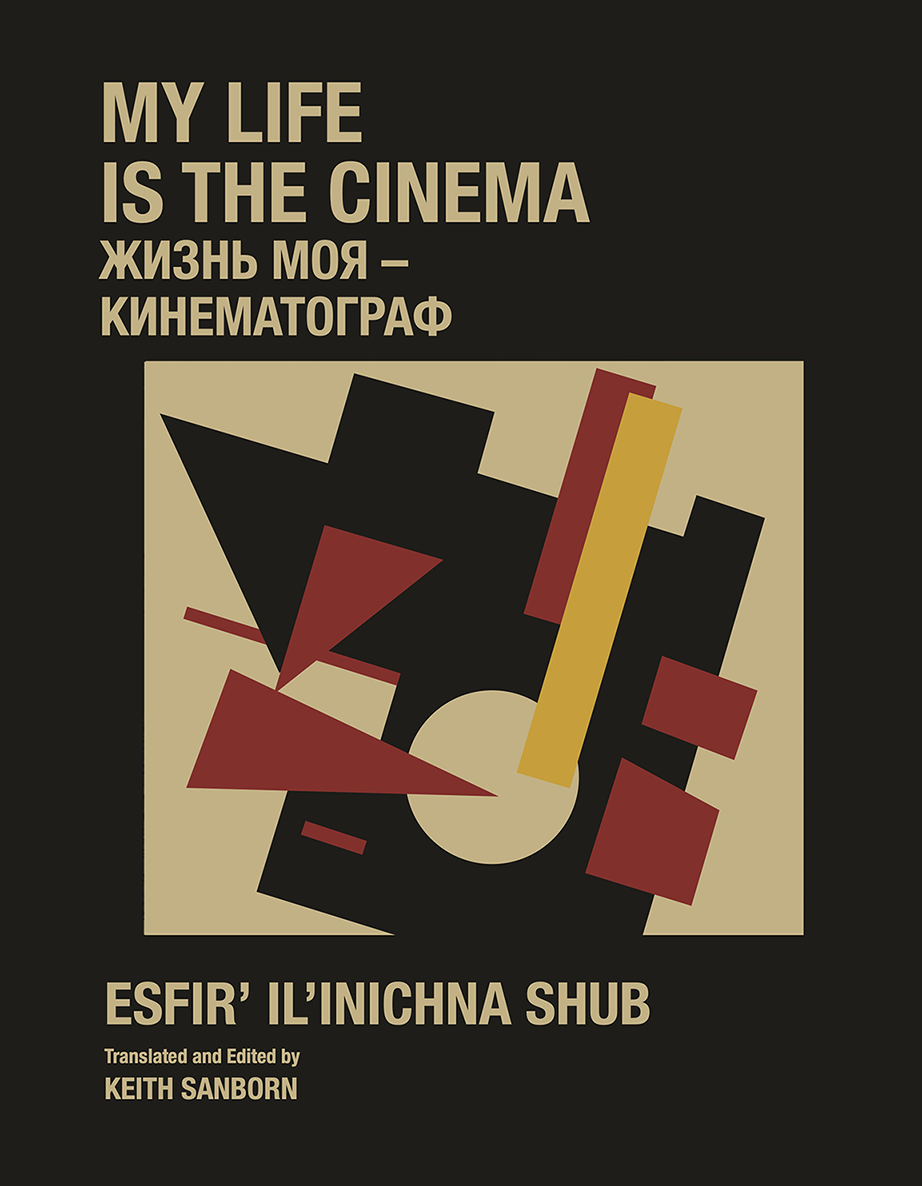
Translated and Edited by Keith Sanborn
My Life is the Cinema brings to English readers for the first time the memoirs and selected writings of Esfir' Shub, the pioneering Soviet filmmaker whose archival works transformed the practice of documentary cinema. A comrade of Sergei Eisenstein and Dziga Vertov, Shub was among the first to recognize montage as both an artistic and historiographic method, an instrument through which the political and emotional truths of the twentieth century could be revealed. Her landmark film The Fall of the Romanov Dynasty (1927) established the compilation documentary as a distinct genre, reshaping the relationship between image, history, and ideology.
This volume, translated and edited by Keith Sanborn, includes Shub’s autobiographical text In Close Up, articles, unrealized film projects, correspondence, and rare theoretical reflections on editing, authorship, and the ethics of representation. Supplemented by newly translated letters and critical essays, My Life is the Cinema restores Shub to her rightful place within the history of world cinema as a writer, theorist, and “sorceress of the editing table” whose work continues to inform debates on montage, feminism, and the politics of the archive.
Here for the table of contents.
Keith Sanborn has produced an exacting and scrupulously annotated translation of the memoirs and writings of Esfir’ Shub, the leading Soviet-era female filmmaker whose contributions to the cinema are still too little known. This compendium provides new insights into her strident advocacy and plans for new fact-based films re-purposed from pre-existing footage: the ‘compilation film,’ a novel documentary genre that is very much alive today.
Stuart Liebman, Emeritus Professor,
Film Studies, CUNY Graduate Center
Esfir' Shub (1894—1959) was an editor and theorist whose innovative compilation documentaries laid the groundwork for the use of archival footage in cinema. Trained in literature and theatre before joining the Soviet film industry in the early 1920s, she gained prominence for her 1927 film The Fall of the Romanov Dynasty, a ground-breaking assemblage of newsreel footage and archival documents that reinterpreted history through a revolutionary lens. Shub’s work explored the ideological and aesthetic possibilities of montage while maintaining a distinct, analytically reflective approach to editing. As one of the first women to achieve prominence in Soviet cinema, her writings on film editing and historical representation remain foundational to documentary theory and film historiography.